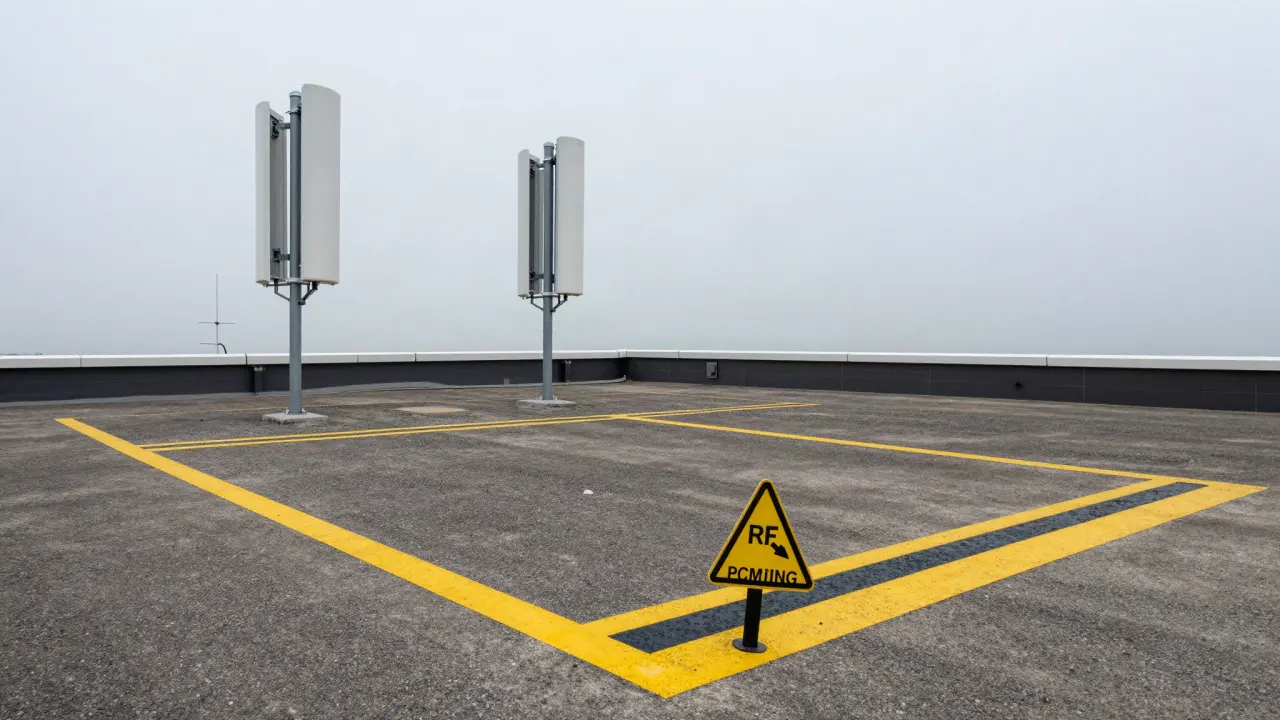
OET-65 in 60 Seconds: How the FCC MPE Limits Actually Work
A field-engineer's plain-English summary of the General Public and Occupational MPE limits, why they're frequency-dependent, and how time-averaging changes the answer.
The two-tier system#
FCC OET-65 separates RF exposure into General Public / Uncontrolled and Occupational / Controlled populations. The Occupational limit is five times the General Public limit on a power-density basis, with a 6-minute time-averaging window vs. 30 minutes.
Frequency-dependent limits#
Below 30 MHz the limit is set by E-field and H-field. Between 30–300 MHz it's a flat 1.0 mW/cm² (Occupational) / 0.2 mW/cm² (General Public). Between 300 MHz and 1.5 GHz the limit scales linearly with frequency. Above 1.5 GHz it caps out at 5.0 / 1.0 mW/cm². My tools page has a live calculator that gives both limits for any frequency.
Why this matters at a real site#
The instantaneous transmit power at the antenna port is rarely the right number to compare against the limit. Time-averaging, contribution from every band on the structure, and the actual occupied space all change the result. A defensible OET-65 evaluation walks through each of these.

Comments
No comments yet. Start the conversation.